
The June 30 Goldmine: How to Build Your Out-of-Contract Shortlist Before the Window Opens
Every summer, hundreds of proven players become available for free. Here's how smart scouting departments are identifying and securing them before the chaos of the transfer window begins.

Every year on July 1, the same scramble happens. Clubs suddenly realize they've missed a window that had been open for months. Out-of-contract players — some of them genuinely elite — are already committed elsewhere. The clubs that signed them did not get lucky. They planned in January.
May is the last real opportunity to act before the summer market becomes noisy, expensive, and reactive. If your shortlist of expiring contracts isn't already built and prioritized, this article is your reminder to build it today.
Why Free Transfers Are the Most Undervalued Asset in Football
The romanticism around big fees distorts how clubs actually build squads. Look at the most efficiently assembled rosters across the Champions League this season: a significant portion of key contributors arrived on pre-contract agreements or as free agents. No transfer fee means the entire budget can go toward wages and signing bonuses — and you're negotiating from strength, not desperation.
Yet most scouting departments treat free transfers as an afterthought rather than a first-order strategy. The reason is structural: identifying out-of-contract talent requires earlier intervention, a wider data sweep, and better cross-department communication than chasing a player another club is selling.
When Contracts Actually Expire — and When to Start Watching
The June 30 expiry date is well known. What's less understood is the timeline before it.
- September–November: Clubs begin internal reviews of squad contracts expiring the following summer. A player not offered an extension by November is often quietly available.
- January: Pre-contract agreements open for players in the final six months of their deal. European clubs — especially German and Portuguese sides — are aggressive here.
- February–April: The player's agent is typically running parallel conversations. If you haven't made contact by March, you're in a bidding war you didn't know existed.
- May: Last-chance saloon for pre-contract. Players without an agreement are either close to signing one or genuinely undecided.
If you are reading this in May and have not mapped your targets, you are not too late — but you need to move this week, not this month.
Building the Shortlist: A Systematic Approach
The mistake most departments make is starting from names rather than from criteria. Before you open a database, define the profile:
Position and role specifics. Not "central midfielder" but "ball-progressive 8 who can operate in a high press, aged 23–28, has Champions League minutes." The tighter the profile, the faster the filter.
Contract status as a primary filter. Most scouting platforms allow you to filter by contract expiry. Run your position filters and immediately limit results to players with contracts ending June 2026 or December 2026. This is your universe.
Performance thresholds. Set minimum benchmarks — minutes played, progressive carries per 90, whatever your model prioritizes. Remove anyone below the floor. You're not looking for potential at this stage; you're looking for proven output at or near your level.
Contextual check. Data does not tell you why a player is leaving. A quick conversation with a trusted agent network, or a scan of club press, often reveals whether the departure is amicable, the result of a falling out, or driven by wage demands your club cannot meet.
The output of this process should be a tiered list: five to eight genuine targets, ranked by fit and feasibility.
The Conversation You Need to Have Now
Once you have a shortlist, the next move is not to send a formal offer. It's to establish contact through the player's agent to confirm interest is mutual and understand the landscape.
You want to know:
- Is the player actively looking, or waiting on a renewal?
- What are the wage expectations?
- Are there other clubs in serious talks?
This intelligence shapes your approach. A player waiting on a renewal from a Champions League club is a different negotiation from one who has been told he is leaving.
Do not outsource this entirely to your agent network. The head of scouting or sporting director should be directly involved in at least the tier-one targets. Players and their representatives notice when conversations happen at the right level.
What Platforms Give You an Edge Here
This is where modern scouting infrastructure separates clubs that move first from clubs that move fast. A platform that centralizes your contract-expiry watchlists, links them to your internal scouting notes, and flags changes in player status saves the hours of manual coordination that most departments still rely on.
The goal is not to use more data — it is to compress the time between insight and action. By the time a name appears in a media report as "available this summer," you should already have your position established.
The Bottom Line
Free transfers are not a consolation prize. They are a market inefficiency that disciplined scouting departments exploit every single summer. The clubs winning this game are the ones that treat contract expiry tracking as a continuous process, not a June exercise.
Your shortlist should be in your hand today. If it isn't, start building it now — before the window opens and the opportunity quietly closes.
The Central Hub for Football Scouting
One platform to consolidate your scouting tools, centralize player data, and enhance every evaluation with AI.
Not ready to talk yet? Start with a free tool.
Shadow Team BuilderFree tool to build and share a shadow team on a formation.
Keep reading

Athleads vs Scoutastic: An Honest Comparison
Both are scouting platforms with AI, report templates, shadow teams and mobile apps. The differences are in how you pay, how much the tool bends to your process, and how much of your scouting it brings into one place.

Athleads vs Wyscout: Which One Does Your Scouting Department Need?
Wyscout is where you watch players. Athleads is where everything else about them lives: every provider's data, every report, salary expectations and the department's workflow, on one player profile. Here is how they differ, how they work together, and what each costs to grow.
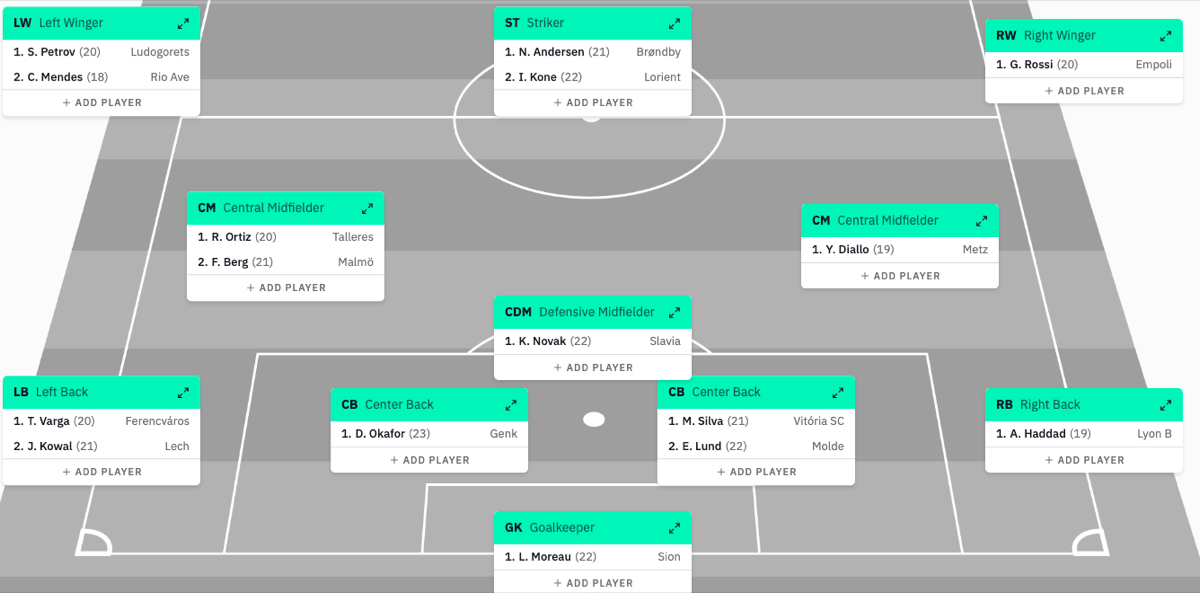
How to Build a Shadow Team That Your Sporting Director Will Actually Use
A shadow team turns a long list of names into a plan for every position. How to build one from your own squad outwards, what to record for each player, a worked example, and the mistakes to avoid.